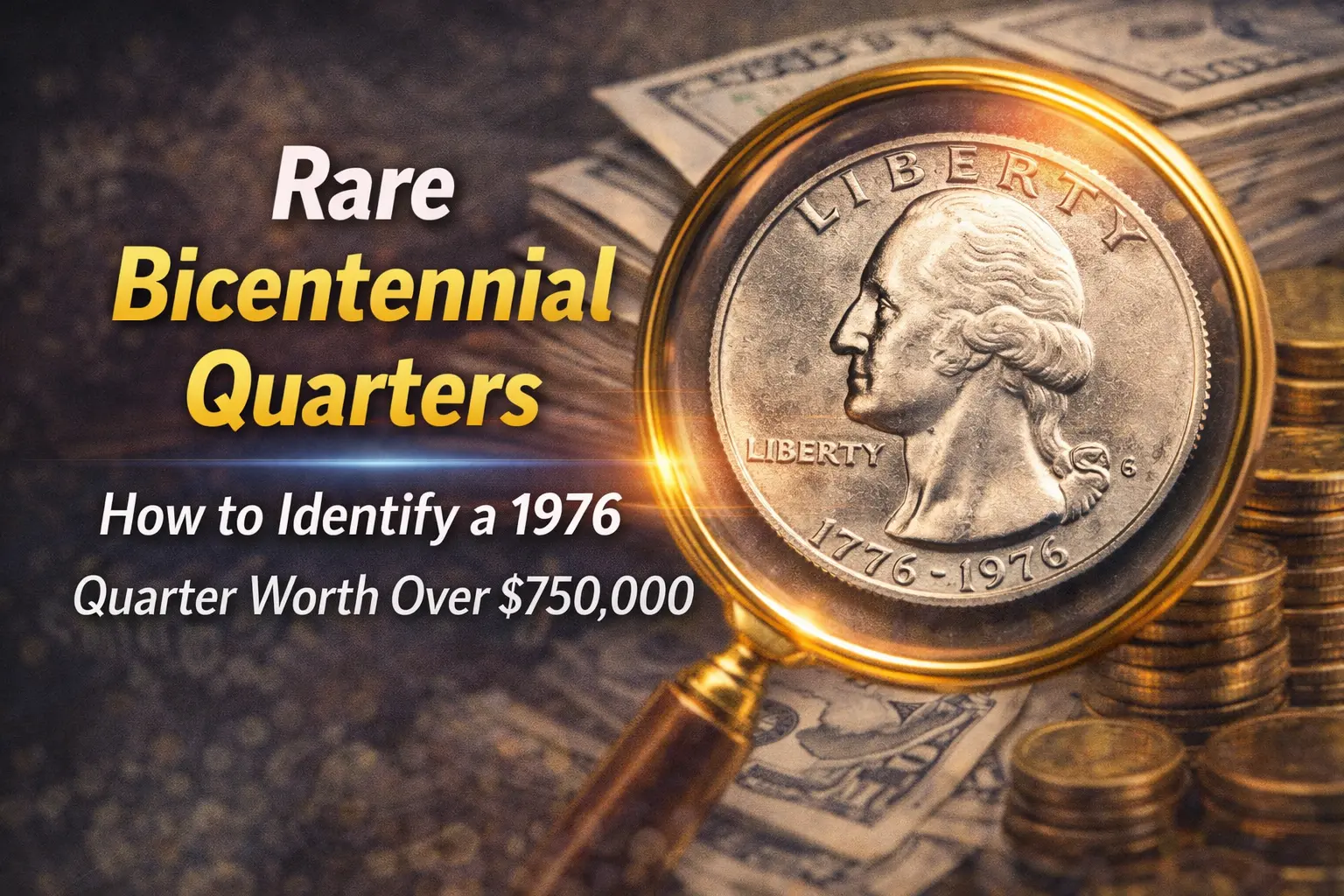
The 1976 Bicentennial Quarter is one of the most recognizable U.S. coins ever minted. Featuring a colonial drummer on the reverse and the dual date 1776–1976, millions of Americans have handled this coin without giving it a second thought.
But here’s the surprise: a very small number of Bicentennial quarters are worth far more than face value—some selling for hundreds of thousands of dollars, and in rare cases, approaching the $750,000 mark at elite auctions.
So what separates an ordinary Bicentennial quarter from a life-changing one? Let’s break it down.
Why Most Bicentennial Quarters Are Worth Only 25 Cents
Before chasing lottery dreams, it’s important to understand the baseline reality:
- Over 1.6 billion Bicentennial quarters were minted
- Most were struck in copper-nickel clad
- The vast majority remain worth face value
If your quarter looks normal, circulated, and weighs about 5.67 grams, it’s almost certainly not rare.
The big money comes from specific compositions, mint errors, and ultra-high grades.
The Bicentennial Quarter That Can Reach $750,000+
The headline-grabbing valuations apply only to extremely rare variants, typically combining multiple rarity factors.
The Most Valuable Known Examples Include:
- 1976-S 40% Silver Proof quarters
- Severe mint errors
- Perfect or near-perfect grading (MS69–PR70)
- Auction-verified provenance
In exceptional cases, a Bicentennial quarter that meets all these criteria has sold for six-figure sums, with private estimates reaching $750,000+ depending on demand and condition.
These are museum-level coins, not pocket change finds.
Key Features to Check on Your 1976 Quarter
Check the Mint Mark
Look just to the right of Washington’s ponytail:
- No mint mark → Philadelphia (common)
- D → Denver (common)
- S → San Francisco (important)
Only “S” mint quarters were struck in 40% silver or proof finishes.
Weigh the Coin (Critical Step)
Use a precise digital scale:
- Copper-nickel quarter → ~5.67 grams
- 40% silver quarter → ~5.75 grams
That tiny difference can mean thousands of dollars.
Inspect the Edge
- Copper-nickel coins show a brownish copper stripe
- Silver quarters have a solid silver edge with no stripe
No stripe = stop and investigate further.
Look for Rare Mint Errors
Some errors dramatically increase value:
- Double die obverse or reverse
- Off-center strikes
- Clipped planchets
- Wrong metal planchet
- Proof coins struck on silver blanks intended for other denominations
Even moderate errors can fetch $5,000–$50,000 depending on severity.
Condition Is Everything (Grading Matters)
Professional grading is non-negotiable for high values.
- MS65–MS67 → valuable
- MS68+ → extremely rare
- PR70 (perfect proof) → elite collector status
Coins graded by PCGS or NGC dominate record sales.
Realistic Value Ranges (What Most People Find)
Let’s ground expectations:
| Type | Approx Value |
|---|---|
| Circulated clad | $0.25 |
| Uncirculated clad | $1–$5 |
| 40% silver | $10–$30 |
| Silver proof (PR69+) | $100–$15,000 |
| Major error + top grade | $50,000–$750,000+ |
Only a tiny fraction reach the top tier.
Should You Get Your Coin Graded?
Yes—only if:
- It’s silver
- It shows a clear mint error
- It appears uncirculated or proof-like
Grading costs typically range from $30–$100, but it’s essential for any serious valuation.
Where High-Value Bicentennial Quarters Are Sold
Record-breaking coins usually sell through:
- Heritage Auctions
- Stack’s Bowers
- GreatCollections
- Private numismatic dealers
Avoid social media buyers promising “instant cash” for rare coins.
Final Truth: Rare, But Real
The idea of a $750,000 Bicentennial quarter is real—but extraordinarily rare.
Most people won’t find one in pocket change. However, if you:
- Have a 1976-S quarter
- See no copper edge
- Notice unusual errors
- And the coin looks flawless
…you may be holding something worth far more than 25 cents.
FAQs
Are all 1776–1976 quarters valuable?
No. Most are common and worth face value.
Is the $750,000 valuation guaranteed?
No. It depends on condition, rarity, and auction demand.
Can I find one in circulation?
Extremely unlikely, but not impossible.